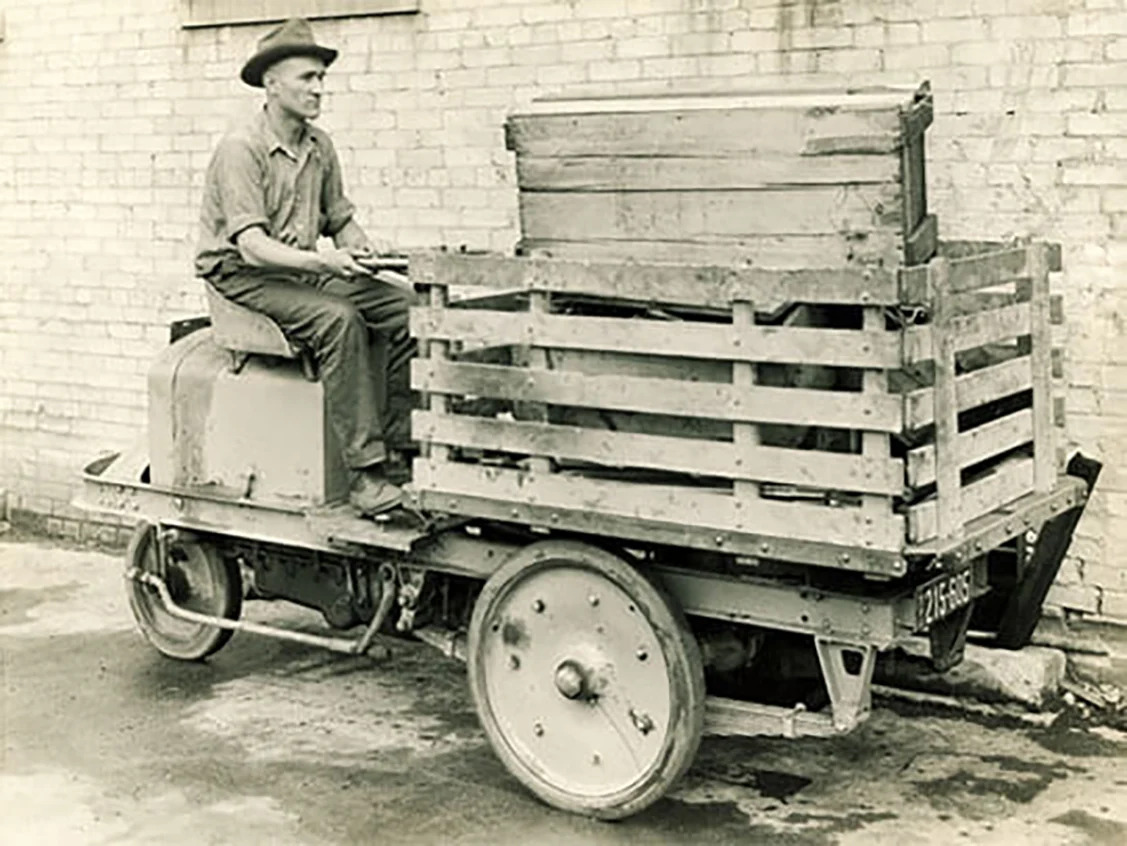
Today we see it as a matter of course to use lift trucks and reach stackers to handle goods in industry, warehouses and ports. It wasn’t always this way. If we go back in time to the beginning of industrialism, most lifting and moving was done by hand. As the demands on efficiency increased, industry saw a need for help with the heaviest lifts. In this post, we´ll take a look at the lead-up to creation of the very first lift truck.
The wheelbarrow - an early aid to industry
The industrial revolution meant a change in work processes where we went from using muscle power to steam-driven machines. The English textile industry is usually mentioned as a forerunner, where mechanical looms were used as early as in 1760. With factory-style production of goods in large quantities, increasingly larger volumes of raw materials and finished products needed to be moved between warehouses, manufacturing and shipping. The need arose for more efficient internal logistics.
One of the first aids used in the factories was the sack wheelbarrow. This simple two-wheeled cart was completely manual, but helped factory workers more easily move large and heavy goods, for example sacks full of flour and seed.

A manual predecessor to the truck
During the second half of the 19th century, several patent applications were filed in the United States describing mechanical platforms that could both lift and move goods. The first patent was filed in 1867 by R.M. Van Sickler and was described as "a new and improved elevator". In the patent application, it was stated that the device could easily “be pushed to the desired spot, and a box or other heavy article can be raised and deposited in the required place”.
What is this if not a manual precursor to today's forklifts? Van Sickler's patent described a simple construction with an upright frame and a platform that could be raised by means of cranks. Workers could now move heavy goods in a simpler and gentler way--a revolution from both an ergonomic and efficiency perspective.
Discover related articles